 EN
EN
 INA
INA
From Evidence to Impact: Putu Velyniawati’s Journey in Epidemiology, Community Engagement, and Health Systems Strengthening
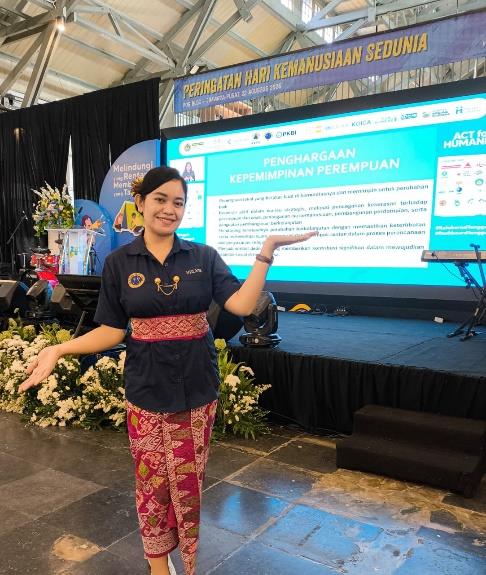
Putu Velyniawati’s journey in public health began not only with academic training, but with a deep commitment to understanding how health challenges are shaped by communities,
systems, and behaviors. Trained as a field epidemiologist at Universitas Udayana, she developed a strong foundation in evidence based analysis, while cultivating an approach that consistently connects data with real world impact.
Her early work in rabies prevention in Bali became a defining turning point. Working closely with communities, government institutions, and international partners, she was not only implementing programs but also navigating complex social and political dynamics. Through this experience, she learned that controlling disease is not solely a technical challenge. It requires trust building, cross sector collaboration, and the ability to translate science into actions that communities can accept and sustain. Her contribution to the establishment of rabies control regulation in Bali reflects this intersection between science, policy, and community engagement.
Alongside her programmatic work, Velyn has continuously engaged in research activities in affiliation with Universitas Udayana, collaborating with academic researchers to generate evidence that informs both policy and practice. Her epidemiological background has enabled her to contribute to study design, data analysis, and interpretation, particularly in areas related to zoonotic diseases, community behavior, and public health interventions. This dual role has positioned her to bridge the gap between research and implementation, ensuring that field insights inform research questions, and that research findings are translated into actionable strategies.
As her career progressed, Velyn expanded her role into larger scale public health interventions. Through her work with the World Mosquito Program and Save the Children, she led risk communication and community engagement strategies for Wolbachia deployment in Bali. In this role, she managed public perception, addressed misinformation, and strengthened community trust in innovative vector control technology. By integrating social research, stakeholder mapping, and strategic communication, she contributed to achieving high levels of community acceptance, demonstrating that even the most advanced scientific interventions depend on effective engagement and governance alignment.
Her expertise in epidemiological thinking also plays a critical role in supporting donor engagement and proposal development. She contributes to framing public health problems, identifying evidence gaps, and aligning program design with data driven justifications required by donors. Through collaboration with multidisciplinary teams and researchers, she helps ensure that proposals are not only technically sound but also grounded in contextual realities and measurable impact pathways.
Her work further evolved into bridging public health with broader development agendas. As a consultant with UN, she integrated gender equality, social inclusion, and governance into community engagement strategies in Eastern Indonesia. She supported the institutionalization of these approaches within village planning and budgeting processes, ensuring that interventions are not only implemented but sustained within local systems. This reflects her growing focus on long term systems strengthening rather than short term program delivery.
Currently, she continues her work in strengthening systems and organizational effectiveness in the private sector, where she applies epidemiological thinking to operational and management challenges. By identifying inefficiencies, analyzing patterns, and developing structured solutions, she demonstrates that the core principles of epidemiology are highly transferable beyond public health. Across all her roles, a consistent thread defines her work. She approaches problems through data, prioritizes based on impact, and designs solutions that are both technically sound and socially grounded. Her experience across research, community programs, global health initiatives, and organizational systems positions her as a professional who is able to operate at the intersection of science, policy, implementation, and strategic partnerships.
Looking forward, Velyn is driven by a vision of building resilient systems that are adaptive, inclusive, and evidence driven. She believes that the future of public health lies not only in innovation, but in the ability to translate that innovation into solutions that are trusted, adopted, and sustained by communities.

MEDICAL FACULTY