 EN
EN
 INA
INA
Expertise Group (KBK) in the field of Environmental Health
Brief Description
The Environmental Health Expertise Group (KBK) is an academic and scientific unit that focuses on the study, development, and application of knowledge in Environmental Health. It addresses the interaction between environmental factors—physical, chemical, biological, and social—and human health, with the aim of preventing disease and improving quality of life.
The group is responsible for delivering education, conducting research, and implementing community engagement activities in key areas such as water and air quality, sanitation, waste management, occupational health, environmental toxicology, and climate change.
Through research and collaboration, the KBK generates evidence to support policy development and practical interventions, particularly in addressing environmental health challenges at local and regional levels.
Background
Environmental health constitutes a fundamental determinant of population health outcomes. Evidence from the field of Environmental Health consistently demonstrates that a substantial proportion of the global disease burden is attributable to environmental risk factors, including unsafe water, poor sanitation, air pollution, and inadequate waste management.
In Indonesia, environmental health challenges remain significant. Persistent issues include limited access to safe water and sanitation, suboptimal waste management systems, and increasing exposure to environmental pollutants.
The situation is particularly relevant in Bali, where rapid tourism development has intensified environmental pressures such as increased waste generation, groundwater contamination, and air pollution from transportation and economic activities.
Research Roadmap
This research is part of a medium-term research roadmap developed by the Environmental Health Expertise Group in collaboration with the Lebih Beach Tourism Management Agency, Gianyar.
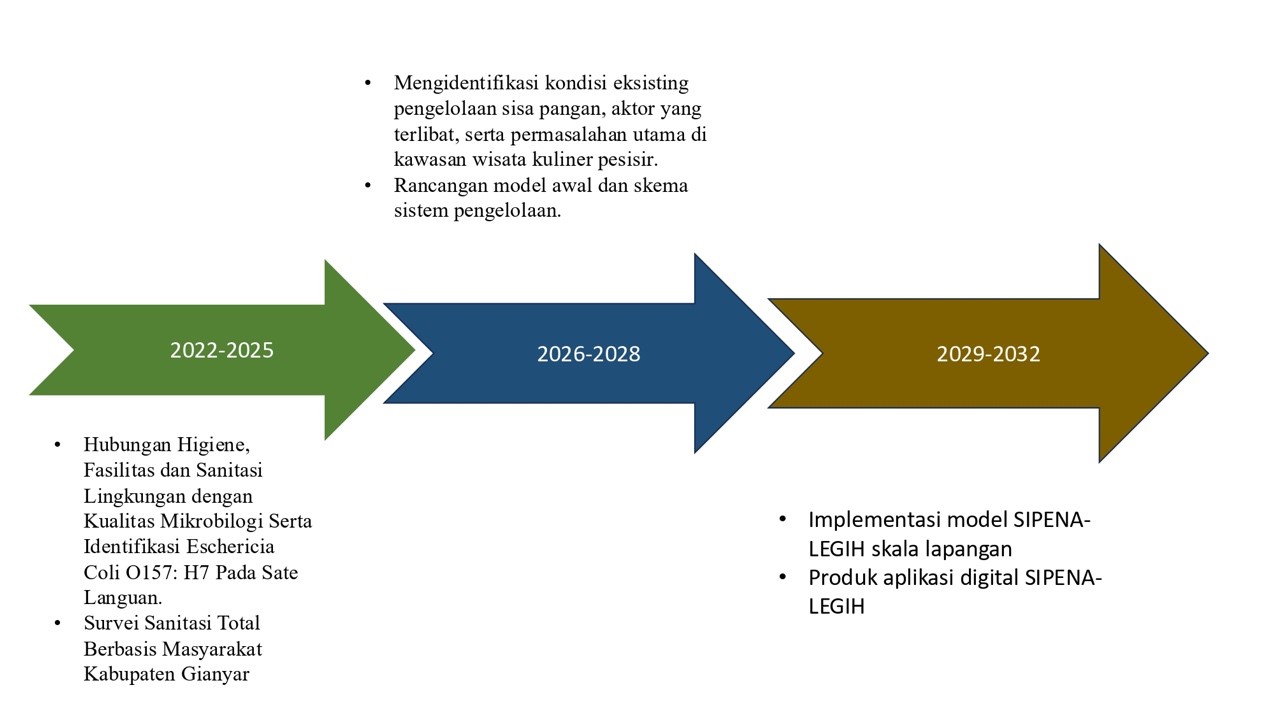
Development of the SIPENA LEGIH Sanitation Model for Food Waste Management in the Coastal Culinary Tourism Area of Lebih Beach, Gianyar.
The initial phase of the research focused on identifying microbiological risks associated with food safety in the Pantai Lebih culinary tourism area. The current research phase focuses on developing the SIPENA LEGIH model through needs analysis, conceptual design, expert validation, and pilot implementation.
Future stages will include prototype development, intellectual property protection, and collaboration with government agencies, tourism stakeholders, and local communities.
Research Group Leader
NIP: 198409112008011004
Academic Position: Associate Professor
Speciality: Environmental Health
Email: sangpurnama@unud.ac.id
Members
| Name | Academic Position | Speciality |
|---|---|---|
| Ni Made Utami Dwipayanti, S.T., M.BEnv., Ph.D | Assistant Professor | Environmental Health |
| Made Ayu Hitapretiwi Suryadhi, S.Si., M.H.Sc., Ph.D | Lector | Environmental Toxicology |
| I Gede Herry Purnama, ST., MT.MIDEA | Lector | Waste Management |
Selected Publications
- Cho, Z. et al. (2024). Development of integrated assessment tool for water, sanitation and hygiene services under climate change context. Heliyon.
- Ciawi, Y. et al. (2025). Multilayer packaging recycling: challenges, current practices, and future prospects.
- Dwipayanti et al. (2025). Socio-ecological barriers to women’s empowerment in sanitation in Eastern Indonesia. Health Place.
- Hitapretiwi et al. (2019). Nitrogen dioxide and acute respiratory infections in children in Indonesia.
- Purnama, S. G. et al. (2022). Attitude towards dengue control efforts using digital technology during COVID-19.
- Purnama, S. G., Subrata, M., & Kardiwinata, P. (2022). Spatial distribution of dengue and forecasting in South Denpasar.


MEDICAL FACULTY